
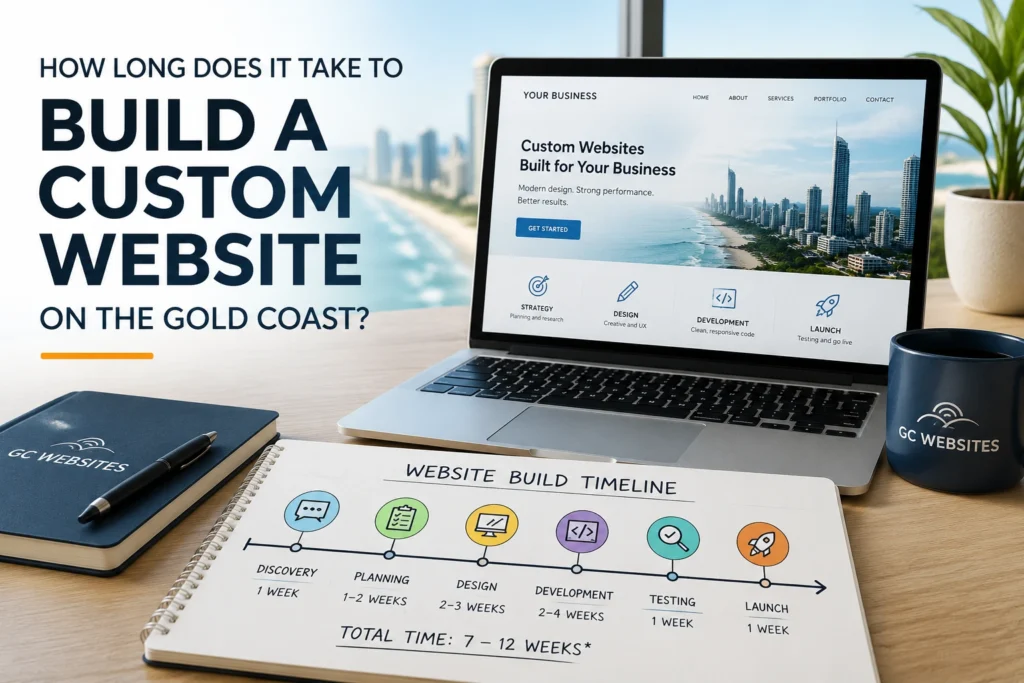
One of the first questions we get asked is simple: how long will this take? That is a fair question. If you are planning a custom website launch, replacing an outdated site, or trying to line your website up with a marketing push, you do not want vague answers. You want a realistic timeframe.
The honest answer is that custom website projects do not all move at the same speed. On our homepage, we explain that website design projects can take anywhere from a few weeks to several months depending on the scope and other project factors. We also make it clear that we focus on a timeline and end date so the project is ready to launch at the right time for the business.
There is no single timeline, but there is a realistic range
A custom website is not a one size fits all product. A small brochure style site with clear content and quick approvals can move much faster than a larger custom build with multiple stakeholders, service pages, content gaps, integrations, or detailed revision rounds.
That said, there should still be a realistic range. A good website process should not leave you guessing. It should give you a clear sequence, practical milestones, and a launch target that reflects the actual work involved. On GCWebsites’ live pages, that structure is visible in both the homepage guidance and the WordPress service workflow.
What usually determines how long a website build takes
Two factors shape timing more than most people expect.
Project scope and page count
A five page site and a twenty page custom website are not the same job. More pages usually mean more design decisions, more content handling, more internal review, and more testing. If the website also needs custom layouts, booking logic, eCommerce elements, or deeper SEO structure, the timeline naturally expands.
Content readiness and asset collection
This is one of the biggest hidden variables. If the core messaging, page content, service information, brand assets, and imagery are ready early, a website project tends to move more smoothly. If content is still being written, reviewed, or collected during development, that can slow momentum across the whole build.
Our homepage touches on this directly by saying faster turnaround works best when the client has a solid plan and stays open to regular communication with the team around strategy, design, content, and related work.
The four stages that shape a proper custom website timeline
On our WordPress service page, we lay out the process in four stages: Planning & Strategy, Design & Develop, Optimise & Test, and Launch & Maintain. That is a useful way to understand where the time actually goes.
Planning and strategy
This is where the direction gets set. It is the stage that prevents the rest of the project from drifting.
Design and development
This is where the website starts taking shape visually and functionally, usually across milestones and review points rather than one single handover.
Optimisation and testing
This stage checks how the site performs across devices, improves the user journey, and tightens content and layout decisions before launch.
Launch and post launch support
A proper launch includes more than publishing pages. It should include a smooth handover, support, and clarity around what happens next.
What happens during planning and strategy
Planning is often the part buyers underestimate because it is less visible than design. It is also one of the parts that saves the most time later.
Clarifying business goals saves time later
On the live WordPress service page, GCWebsites says this stage is about understanding the business, goals, brand identity, and the message the website needs to convey to the target audience, then building a strategy that aligns the website with broader business objectives.
That matters because websites run slower when those questions are not settled early. If the team is still trying to define positioning, audience, or page purpose halfway through design, revisions multiply and decisions become slower.
Why design and development rarely move in one straight line
A custom website usually moves through stages, not a perfectly straight line.
Milestones, feedback, and responsive design all affect timing
The same service page explains that the design and development phase is based on client input over several milestones, with the goal of creating a responsive, user friendly website that balances design and experience.
That is important because review rounds are normal. They are not a sign something is going wrong. Good projects need space for feedback, refinement, and decisions. What slows them down is not the existence of review cycles. It is unclear feedback, delayed responses, or major direction changes once the work is already underway.
Testing is the stage buyers forget, but it protects the launch
This is one of the easiest parts to overlook when someone is focused on speed.
Device checks, content refinement, and user experience improvements
GCWebsites’ published process describes the optimisation and testing stage as a time to improve content, user experience, and design across devices so the target audience gets a stronger experience on every screen.
That is not a delay. That is quality control. A site can look finished in a design preview and still need work before it is genuinely ready for real users.
What slows custom website projects down most
Some delays come from complexity. Others come from avoidable project friction.
Delayed feedback
If approvals sit for too long, the timeline stretches quickly. Even a well structured process loses momentum when decisions stay open for days or weeks.
Missing content
When key pages do not have approved copy, offers, service descriptions, or media assets, the design and build phases become harder to finalise.
Scope changes mid project
Small adjustments are normal. Major additions midway through the build usually affect timing because they change the amount of work, the page structure, or the approval process.
This pattern also appears across larger Australian digital projects. The Australian Government’s Major Digital Projects Report 2026 found that 52.9% of completed projects had changed their end date since the previous report, with one-third of those projects experiencing a delivery delay. Additional scope introduced after a project had commenced was identified as one of the main reasons for schedule extensions.
Trying to rush decisions that need clarity
Speed helps when the direction is already clear. It hurts when teams force quick answers to questions that still need proper thought. That often creates more revisions later, which ends up taking longer overall.
How to move faster without cutting corners
There are practical ways to improve turnaround without compromising the quality of the launch.
Have goals, content, and decision makers ready
The more clarity you bring into the project, the smoother the build tends to be. If your core business goals, service priorities, content direction, and internal sign off process are ready early, the project can move with more confidence.
Stay available for regular communication
On the homepage, GCWebsites says faster turnaround is easier when the client has a solid plan and stays available for regular communication with the team.
That is exactly right. Website projects move best when both sides stay engaged.
What a realistic timeline can look like for different custom website types
There is no fixed promise that fits every website, but there are useful ranges buyers can work with.
Small brochure style business site
A smaller site with a clear brief, ready content, and fast approvals can often move on the shorter end of the range discussed on the homepage.
Mid size custom service website
A more developed service based site usually takes longer because it needs more structured content, stronger page hierarchy, more refined messaging, and more review points.
Larger or more strategic build
The timeline expands further when the project includes a broader strategy layer, custom functionality, significant content support, or more complex internal decision making. That is why “a few weeks to several months” is a more honest public range than a single hard number.
Why the fastest website is not always the best website
It is natural to want the quickest possible launch. The risk is assuming that fast automatically means efficient.
A rushed launch can create slower growth later
If the strategy is weak, the structure is unclear, the content is undercooked, or the testing is cut short, the website may launch sooner but underperform later. That creates a different kind of delay, because now the business has to fix issues after launch instead of preventing them during the build.
A better question than “How fast can this go live?” is “How fast can this go live properly?”
What happens after custom website launch is important
A website timeline does not end the moment the site is published.
Training, support, and ongoing maintenance shape the real handover
On the homepage and WordPress service page, GCWebsites states that clients receive ongoing support and maintenance options, and that WordPress builds are designed to be editable after launch. The homepage also says the team implements a training session before handover, while the service page says launch is followed by continuous support, monitoring, and maintenance.
That matters because a good launch should leave the business with confidence, not confusion.
If you want a realistic launch date, start with the right process
If you are comparing web design providers on the Gold Coast, the most useful answer is not the shortest answer. It is the clearest one.
A proper custom website timeline depends on the scope, the content, the speed of decisions, and the way the project is managed. On GCWebsites’ live pages, that process is presented clearly: strategy first, then design and development, then testing, then launch and ongoing support. The business also positions itself as a local Gold Coast team based in Varsity Lakes, with direct contact available by phone or through the enquiry form.
If you want a realistic launch date for your project, the best place to start is with a clear brief and the right process behind it.
Before you ask for a faster website launch, ask these first
How long does a custom business website usually take to build?
A custom website can take anywhere from a few weeks to several months depending on the project scope, content readiness, and approval process. That broad range is consistent with GCWebsites’ published homepage guidance.
What makes one website project take weeks and another take months?
The main factors are scope, number of pages, content availability, feedback speed, and whether the project includes more strategic or technical requirements. Larger builds create more decisions, more review rounds, and more testing.
Can I speed up my website project without sacrificing quality?
Yes, but usually by being more prepared rather than by cutting steps. Clear goals, ready content, and regular communication help a project move faster without weakening the outcome.
Does writing content late slow the whole build down?
Very often, yes. Content affects page structure, messaging, design layout, and approvals, so delays in copy usually affect the wider project.
How many revision rounds should I expect in a custom website project?
There is no one number that fits every project, but custom builds usually move through milestones and feedback points rather than a single draft. GCWebsites’ service page explicitly refers to several milestones during design and development.
What happens after the website goes live?
You should expect a proper handover, clarity around support, and an understanding of how updates will be handled. GCWebsites states that it offers launch support, monitoring, maintenance, and training around editable WordPress websites.
Can a Gold Coast website agency give me a fixed launch date?
A provider can usually give you a launch target once the project scope is clear. The more defined the brief, content, and approval process, the more reliable that target becomes.