
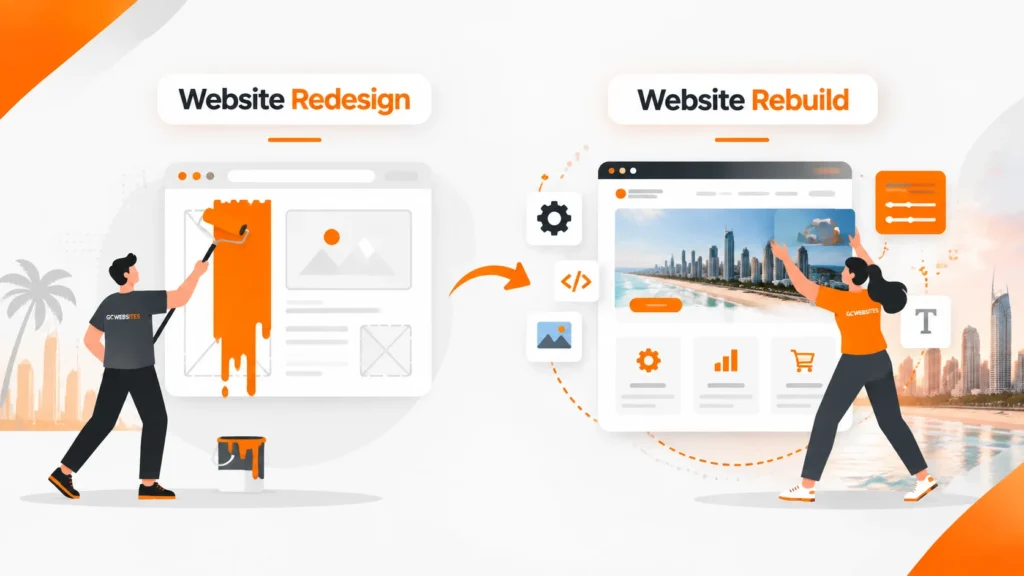
Website redesign Gold Coast decisions should begin with the condition of the website, not simply how old it looks.
A website can look tired long before it stops doing its job. It can also look reasonably modern while carrying years of technical problems underneath.
That difference matters when deciding whether to redesign what you already have or rebuild the website on a stronger foundation.
A fresh layout, better typography and cleaner visuals can transform a website with a sound foundation. They do far less when the site is difficult to update, unreliable on mobile, burdened by ageing technology or unable to support what the business now needs.
That is why we prefer to diagnose the website before prescribing the work.
The first question is not simply, “Does this site look old?” It is whether the current website is still a sound platform for the next stage of the business.
A Website Redesign Should Fix the Problem You Have, Not the One You Can See
Ageing websites often reveal their problems visually first.
The homepage feels dated. Pages are cluttered. The mobile experience is awkward. Competitors may have cleaner, sharper websites. The natural response is to redesign the site.
Sometimes that is exactly the right move.
But the visible design can also be a symptom of a deeper problem.
Can the site be maintained efficiently? Is the content management system still suitable? Are important changes becoming harder to make? Does the site work properly across current devices? Has routine maintenance become more complicated than it should be?
Those answers help determine whether a redesign will solve enough of the problem to justify the investment.
Start With a Website Diagnosis
We approach website redesign as a business decision, not simply a decorating exercise.
That means judging the current website against what the business needs from it now.
A website built five or eight years ago may have suited the company at the time. Since then, the business may have expanded its services, changed its positioning, entered new markets or become more dependent on online enquiries.
The website has to support those changes.
A redesign can work well when the underlying system remains stable and flexible. If the platform itself is holding the business back, further design work can become money spent preserving an old limitation.
Look Beyond an Outdated Design
Older websites can accumulate plugins, abandoned features, inconsistent templates and workarounds added over several years. Mobile behaviour may have been patched rather than properly designed. Editing a simple section can take far more effort than it should.
None of these issues automatically means the site needs replacing.
Together, however, they can change the economics of a redesign.
The more effort required to work around the existing build, the harder it becomes to justify investing further in that foundation.
Keep the Existing Website When the Foundation Still Has Years Left in It
Rebuilding an entire website is not always necessary.
If the existing WordPress setup is stable, maintainable and capable of supporting what the business needs, the focus can remain on improving the customer-facing experience.
That may mean restructuring pages, improving navigation, revising the visual system, strengthening calls to action, updating copy and creating a better mobile experience.
The work can still be substantial. The difference is that the technical foundation continues to justify its place.
A WordPress Redesign Can Be the Sensible Choice
We are more inclined to preserve an existing site when the answers to questions like these are positive:
- Is the WordPress installation healthy and maintainable?
- Can templates and content be edited without fighting the existing build?
- Does the site already support the required functionality?
- Can mobile usability be improved cleanly?
- Can performance issues be addressed without reconstructing large parts of the site?
- Does the current page structure still suit the business and its search strategy?
A site does not need to be perfect to qualify for a redesign.
It needs to provide a foundation worth investing in.
If the customer experience can be improved without carrying serious technical compromises into the finished project, retaining the existing site can be the sensible commercial choice.
Rebuild Before a Cosmetic Refresh Locks You Into Old Problems
Some websites are no longer good candidates for another visual refresh.
Years of modifications can leave behind outdated themes, obsolete plugins, inconsistent templates, difficult content structures and workarounds that make ordinary changes harder than they should be.
At that point, redesigning the visible layer risks producing a better-looking version of the same underlying problem.
Ageing Technology Can Change the Calculation
Technology does not need replacing simply because something newer exists. What matters is whether the existing system remains serviceable.
Assessing the website’s long-term performance requires asking key questions. Will ongoing maintenance remain efficient? Can future business updates be supported without major changes? Does the current structure allow the team to manage content effectively?
An older website that remains structurally sound may still have years of useful life. A website that requires increasingly complicated workarounds deserves closer examination.
The cost of keeping it is not limited to the redesign itself. Ongoing maintenance and future development also form part of the calculation.
Security, Mobile Usability and Maintenance Can Reveal Structural Problems
Mobile, maintenance and security issues do not automatically justify rebuilding a website.
The question is whether the current implementation allows those areas to be managed properly.
Mobile performance is increasingly central to the website experience. The Australian Communications and Media Authority reported that 97% of Australian adults used a mobile phone to access the internet in 2025, while 92% used mobile internet daily.
If responsive improvements require extensive workarounds, routine updates repeatedly cause problems or maintaining the website becomes increasingly difficult, the underlying build may be contributing to the cost.
No website becomes permanently secure because it has been redesigned. Security depends on sound development, responsible maintenance, software updates, hosting and ongoing management.
A rebuild becomes more relevant when preserving the existing structure creates more compromises than replacing it.
Use These Four Tests Before You Put Another Dollar Into the Current Site
The redesign-versus-rebuild decision becomes clearer when the website is assessed in layers.
We generally look at four areas.
1. The Technology
Can the current website still be worked on efficiently?
Look at the CMS, theme or builder, plugins, custom functionality and the overall condition of the implementation.
If a simple change takes hours because the site is difficult to work with, that says something about its future maintenance burden.
2. The Customer Experience
Can visitors find what they need without unnecessary effort?
The website should make sense on desktop, tablet and mobile. Navigation should reflect the services people are actually looking for. Pages should move users towards a useful next step without making them decode the company structure first.
Some experience problems can be redesigned.
Others sit so deeply inside the current templates and content architecture that rebuilding may provide a cleaner solution.
3. Maintenance and Reliability
How comfortably can the website be updated and supported?
Can routine software updates be handled without unnecessary risk? Is the site easy enough to manage that content stays current? Are the same technical problems returning after individual fixes?
A website is a working business asset. Its maintenance requirements form part of its real cost.
4. What the Business Needs Next
This is often the deciding factor.
A website can technically function and still be wrong for the business that now owns it.
Perhaps new services need their own landing pages. Search visibility has become more valuable. The sales process has changed. The company needs better lead generation. An eCommerce function is being introduced. The team needs easier control over website content.
The question is whether the current site can support those requirements without forcing everything through another workaround.
If it can, redesigning may be enough.
If it cannot, rebuilding starts to make more sense.
Redesign or Rebuild? A Quick Comparison
| A redesign may make sense when | A rebuild may make sense when |
| The existing WordPress setup remains stable and maintainable | The existing build has become difficult to maintain |
| The main problems involve design, navigation or customer experience | Technical and structural problems sit beneath the visual design |
| Existing functionality still supports the business | The website no longer supports required functionality cleanly |
| Mobile usability can be improved within the current build | Mobile improvements require extensive workarounds |
| Templates and content remain practical to edit | Routine changes are difficult or create new problems |
| The current page structure still suits the business and search strategy | The structure no longer reflects the business or its future requirements |
The table is a guide rather than a substitute for assessing the individual website. Several issues together usually matter more than one isolated problem.
The Cheapest Website Option Can Become Expensive if You Have to Fix It Twice
Website decisions are often framed around the price of the next project.
A better comparison is the total cost of reaching the result the business actually needs.
Imagine spending money redesigning an ageing website while leaving its main structural limitations untouched. The site looks better, but the technical restrictions remain.
Six or twelve months later, the business wants another feature, a revised service structure or a more serious SEO campaign and discovers that the underlying platform still needs replacing.
The business has effectively paid for part of the website twice.
That does not mean rebuilding is always the better financial decision. An unnecessary rebuild wastes money too.
The value comes from making the diagnosis before committing heavily to either path.
A useful proposal should explain what can stay, what needs changing and what risks remain under each option.
A Rebuild Should Give the Business More Than a New Coat of Paint
A proper rebuild creates an opportunity to reconsider the website as a whole.
That includes page structure, mobile behaviour, editing experience, functionality, search foundations, calls to action and long-term maintainability.
For businesses considering a broader change, our WordPress web design service is the natural next step from the diagnostic process.
We specialise in WordPress because it gives businesses a flexible platform that can be managed and extended as their needs change.
The goal is to build a website the business can keep using, rather than one that becomes difficult to work with as soon as requirements evolve.
What We Assess Before Planning a WordPress Website Rebuild
The first question is what deserves to survive the old website.
Existing content may still be useful. Some pages may already attract search traffic. Certain functions may work well. The visual identity may only need refinement.
Rebuilding should not mean throwing away useful assets without examining them.
For a site with an established search presence, current URLs, page content, internal links and the structure search engines already understand also need consideration.
A careless rebuild can erase value that took years to build.
Planning allows us to decide what stays, what moves and what should be replaced.
Website Redesign and Maintenance Belong in the Same Conversation
Launch day is only one date in the life of a website.
WordPress evolves. Plugins change. Businesses add services and content. Security needs ongoing attention. Hosting performance still shapes the experience visitors receive.
That is why we treat maintenance as part of the website conversation rather than something to consider later.
Our [website hosting and support service – replace with verified live URL] is built around that ongoing requirement.
A website should have a clear home, a maintenance process and somewhere to turn when technical work is needed.
The finished design is only part of the job. The site also has to stay usable.
Get the Diagnosis Right Before You Commit to the Build
A business with an ageing website does not always need a completely new one.
It does need an accurate picture of what is holding the current site back.
Sometimes the foundation remains sound and a thoughtful redesign can improve the customer experience, presentation and usability.
In other cases, preserving the old build would mean carrying too many technical compromises, workarounds or maintenance problems into the next version.
The important part is identifying the difference before spending money fixing the surface.
If your website is old, underperforming or becoming harder to manage, talk to our GC Websites web design team. We can look at what you already have, what the business needs next and whether redesigning or rebuilding gives you the cleaner path forward.
The Questions We Ask Before Recommending a Website Redesign
How Do I Know Whether My Website Needs a Redesign or a Complete Rebuild?
Start by separating visual problems from structural ones.
A redesign may be suitable if the existing website remains maintainable and flexible enough to support the changes you need. A rebuild becomes more relevant when the platform, architecture or implementation itself is creating the limitation.
We assess both before recommending a direction.
Is an Old-Looking Website Automatically a Reason to Rebuild It?
No.
Visual age tells us very little about the health of the underlying website. The CMS, mobile behaviour, maintainability, functionality and technical condition also matter.
A healthy site with tired styling may be an excellent redesign candidate.
Can You Redesign an Existing WordPress Website Without Rebuilding Everything?
Yes, in the right circumstances.
An existing WordPress website can often be redesigned if its current structure provides enough control to make the required improvements cleanly.
The theme or builder, plugins, templates, content structure and overall technical condition should be assessed before deciding how much of the existing build should remain.
What Problems Usually Point Towards a Complete Website Rebuild?
Several problems appearing together can strengthen the case for rebuilding.
Examples include obsolete technology, difficult maintenance, recurring technical faults, poor mobile behaviour and a structure that no longer supports what the business needs.
The decision depends on the condition of the whole website rather than one isolated fault.
Can Better Hosting or Maintenance Fix an Underperforming Website?
In some cases, yes.
Hosting resources, software updates, plugins, images and technical configuration can all affect performance and reliability.
Those areas should be investigated before treating a rebuild as the default remedy.
A technically sound website should not be discarded because one part of its environment needs attention.
Will Rebuilding My Website Affect SEO?
It can.
A rebuild may change URLs, page structures, internal links, content and technical signals that search engines already understand.
Those elements need to be considered during planning.
Existing pages with value should be identified before launch so the transition can be managed deliberately.
What Should I Do Before Asking for a Website Redesign Quote?
Write down what the current website is failing to do and what you want the next version to achieve.
That could include better mobile usability, stronger lead generation, easier editing, additional services, improved search visibility or new functionality.
A clear list of outcomes helps determine whether the work calls for design changes, technical changes or a new build. It also gives the project a stronger starting point.