
A business can outgrow its website long before the website stops working.
The pages may still load and the contact form may still send enquiries, but the problems become clearer inside the business. Updating a service turns into a technical task. Adding a landing page creates layout problems. The design no longer reflects the standard of the business. New features become difficult or expensive to introduce.
That is often when a business starts considering a new WordPress website.
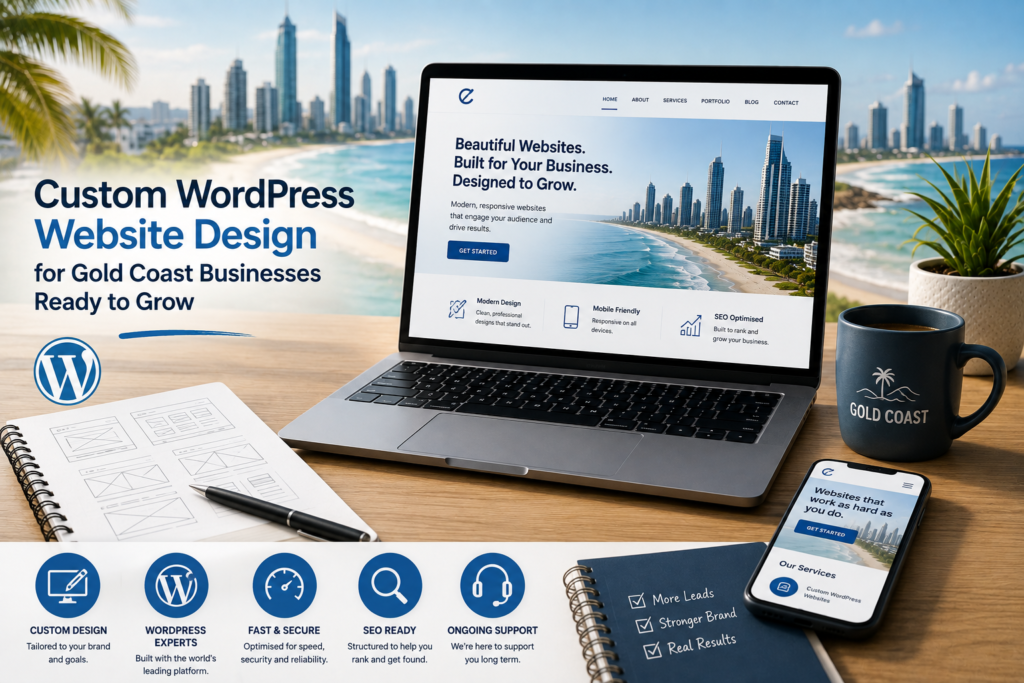
We create custom WordPress websites for Gold Coast businesses that need greater control over their digital presence. Our approach combines WordPress with Elementor to create websites that are easier to manage, adaptable to changing requirements and designed around clear commercial goals.
The website starts with the business. The platform, page structure and design follow from there.
A Restrictive Website Costs More as Your Business Grows
A limited website rarely causes one dramatic failure. The cost usually appears through delays, compromises and workarounds.
A simple content change may require support. A new service has to fit an outdated page structure. A campaign launches without a dedicated landing page because the existing platform makes one difficult to create. Staff may avoid useful improvements because the editing system is confusing or fragile.
Individually, these issues can seem manageable. Together, they slow marketing down and make the website harder to use as a business tool.
A website should support changes in the business. It should make it practical to add services, publish useful content, improve calls to action and introduce suitable functionality without rebuilding the whole site every time requirements change.
Difficult Updates Slow Down Everyday Marketing
Businesses need to make routine changes.
Trading details change. Team members join. Services expand. Offers have deadlines. New customer questions need answers.
If every edit becomes a development task, the business becomes unnecessarily dependent on technical support. It also creates distance between the people who understand the business and the information customers see online.
We use WordPress and Elementor because they can give clients a practical way to manage common content after launch. Text, images, articles and basic page information can be updated through a visual editing environment when the website has been built with a clear structure.
More complex changes may still require development support. Routine publishing should not.
Generic Templates Make Good Businesses Look Interchangeable
A template gives you a predetermined arrangement of sections, styles and page elements. That can work for a straightforward project with limited requirements.
It becomes restrictive when a business has several services, different customer groups or a sales process that needs more explanation.
The issue is not only visual.
A generic structure can put the wrong information first, bury useful evidence or send every visitor through the same journey. It can also force the business to reshape its message around a layout created for somebody else.
We build page structures around what customers need to understand and what the business needs them to do next.
We Build WordPress Websites Around the Business
A custom WordPress website design should explain the business clearly, make navigation straightforward and help visitors take the next appropriate step.
We begin by understanding the services, audience, commercial goals and problems with the current website. From there, we consider which pages are needed, how they should connect and what information a potential customer needs before making an enquiry.
Design follows that planning.
Our website design process moves through planning and strategy, design and development, optimisation and testing, then launch and ongoing support.
That keeps the project focused on what the website needs to achieve rather than treating it as a collection of attractive screens.
Custom Design Gives Every Page a Clear Job
A homepage has a different role from a service page. A service page has a different role from an article, case study or contact page.
Each page should have a clear purpose.
A service page may need to define a problem, explain the service, establish suitability, answer common objections and create a clear path to enquiry.
An article may help someone earlier in the buying process understand a subject before directing them towards a related service.
That purpose affects the headings, copy, visual hierarchy, internal links and calls to action.
It also reduces the risk of building a site where every page repeats the same broad marketing message.
WordPress Creates a Flexible Foundation
WordPress can suit businesses that expect their website to change over time.
A well-planned build can support additional service pages, location content, articles, campaign landing pages, forms and integrations. What can be added will always depend on the website’s technical setup and the requirements involved.
The practical benefit is that the business can continue developing the website it already has instead of treating every new requirement as a reason to start again.
For a Gold Coast service business, that could mean adding another service, expanding into a new service area, publishing stronger project content or creating a campaign-specific landing page.
Elementor Gives You Practical Control After Launch
Control means more than receiving a login.
Website owners need an editing system that makes routine changes understandable. They also need a stable structure that helps protect the design while content is being updated.
We use Elementor as the visual editing layer within WordPress website design. It allows approved users to work with page content through a visual interface rather than editing raw code.
That can make common updates more manageable for business owners and internal marketing staff.
The division of work is straightforward: clients can handle suitable day-to-day content changes, while more involved development, layout changes, maintenance and technical improvements can be handled separately where needed.
Edit Everyday Content Without Touching Code
A business may need to replace an image, correct service information, update staff details or publish a new article.
Those tasks should not require knowledge of HTML, CSS or PHP.
Elementor presents page content through editable sections and widgets. Changes still need care because spacing, hierarchy, mobile layouts and brand consistency matter, but the editing process is more accessible than working directly with code.
We also build with future editing in mind. Reusable styles, consistent sections and sensible page patterns make ongoing content management easier than a collection of disconnected one-off layouts.
Training Makes Website Ownership Useful
Administrator access has limited value if the owner does not know how to use it.
We provide training after launch so clients can understand the areas they are most likely to manage.
This can include editing text, replacing images, publishing content and navigating the WordPress dashboard.
It is also important to understand where caution is needed. Plugin settings, global templates, theme files and technical integrations can affect more than one part of the site.
Knowing which changes are straightforward and which are better handled with support helps protect the website while giving the business practical control.
Full Ownership Keeps Your Website in Your Hands
A business website is an asset. It contains content, customer journeys and marketing work that may have taken years to build.
Ownership should therefore be clear.
Clients should understand what access they receive, which parts of the website they control and whether any software licences, hosting arrangements or third-party subscriptions continue after launch.
Our approach is to provide administrator access rather than keeping completed websites behind restrictive access arrangements.
That gives clients more control over how the website is managed and developed over time.
Your Website Should Remain Portable
Closed website platforms can work well for some businesses, particularly when requirements are simple and the platform provides everything needed.
Problems can appear when the business later requires more control over functionality, design or hosting.
Moving away from a closed platform may involve rebuilding pages, manually transferring content or replacing features that only work inside the original system.
A self-hosted WordPress website uses a different model. In many cases, it can be moved between compatible hosting environments, although the exact process depends on the website’s configuration, licences and third-party services.
Portability gives the business more options if requirements change.
You Can Keep Building on Your Existing Investment
A website project involves more than visual design.
It also includes content, page structure, internal links, forms, integrations and decisions about how visitors move through the site.
A flexible WordPress website design foundation allows future work to build on those decisions.
A new landing page can follow the existing visual system. A new service can fit within the established navigation. New articles can support related service content and strengthen the internal linking structure.
Instead of replacing the website whenever the business changes, the existing site can continue developing in stages.
A Growth-Ready Website Needs More Than a Good Homepage
Visual quality influences how a website feels, but appearance alone does not make a useful business website.
Visitors also need clear information, straightforward navigation and an easy path to enquiry.
They should be able to understand what the business offers, whether it suits their needs and what to do next.
A polished homepage cannot compensate for thin service pages, confusing navigation or forms that are difficult to complete on a phone.
| Area | What a growth-ready website should support |
| Content | Clear service information, useful articles and pages that can be updated as the business changes |
| Navigation | Straightforward paths to important services, information and contact options |
| Mobile | Readable content, usable buttons and manageable forms across smaller screens |
| Conversion | Clear calls to action, suitable forms and trust information placed where visitors need it |
| Expansion | The ability to add relevant pages, content and functionality without rebuilding the entire site |
Mobile Visitors Need a Complete Experience
Responsive design is more than making a website fit different screen sizes.
Australian Communications and Media Authority research found that 97% of Australian adults used a mobile phone to access the internet in 2025, while 92% used mobile internet daily. With mobile access now almost universal, the mobile version of a business website needs to provide a complete experience rather than operate as a reduced version of the desktop site.
Mobile visitors may read content in a different order, use navigation with one hand and make decisions while distracted.
Buttons need enough space. Forms need to be manageable. Text needs to remain readable. Calls to action should appear in sensible places without obstructing the content.
We review website layouts across desktop, tablet and mobile during the build.
Buttons need enough space. Forms need to be manageable. Text needs to remain readable. Calls to action should appear in sensible places without obstructing the content.
We review website layouts across desktop, tablet and mobile during the build.
The aim is to create a complete experience on each device rather than simply shrinking the desktop version.
Search and Conversion Planning Begin During the Build
Search performance cannot be guaranteed by web design alone.
The build can still create a stronger foundation.
Clear page titles, descriptive headings, logical URLs, crawlable content and useful internal links can make the site easier to understand for both users and search engines.
Conversion planning works in a similar way. Calls to action, forms and trust information are more effective when they are considered during the page design rather than added as an afterthought.
Our related guide to high-converting WordPress website design explores these factors in more detail.
Our Four-Stage WordPress Website Design Process
A clear process gives both sides a shared understanding of what happens next.
1. Planning and Strategy
We learn about the business, its customers, services and commercial priorities.
Where a current website exists, we review the problems the new build needs to solve.
This stage informs the sitemap, page requirements, functionality and content direction.
2. Design and Development
We turn the agreed direction into a visual system and page layouts.
Once the design direction is approved, the site is developed in WordPress website design and Elementor.
The design is shaped around the content and customer journey rather than forcing the content into a predetermined template.
3. Optimisation and Testing
We test the website across relevant screen sizes and review its navigation, forms, links and content presentation.
This stage also helps identify unclear sections, inconsistent layouts or technical problems before launch.
4. Launch, Training and Ongoing Support
We prepare the website for launch, complete the agreed checks and provide the appropriate access.
After launch, hosting, maintenance, technical support and website updates can be discussed according to the service arrangement in place.
What Should a Custom WordPress Website Cost?
There is no useful fixed price for every custom WordPress website design.
Cost depends on factors such as the number and type of pages, design requirements, content preparation, forms, integrations, eCommerce functionality and technical complexity.
A straightforward service website and a large WooCommerce project involve very different amounts of work.
For that reason, the more useful question is not simply:
“How much does a website cost?”
It is:
“What does this website need to do, and what work is required to achieve it?”
A Cheap Starting Price Can Hide a Higher Long-Term Cost
A lower quote can be appropriate when the project genuinely has a smaller scope.
It becomes a problem when the price depends on a rigid template, missing functionality or limitations that only become clear after launch.
Later costs may come from workarounds, repeated support requests, manual processes or an earlier-than-expected rebuild.
A useful proposal should explain what is included, what the client can manage, which ongoing costs apply and how future changes will be handled.
Those details usually provide a better basis for comparison than the headline price alone.
A Useful Quote Starts With the Required Outcome
Before a useful quote can be prepared, the required outcome needs to be clear.
A business that needs a straightforward five-page service website has different requirements from one that needs online payments, bookings, gated resources or connections with external software.
The quote should reflect those differences.
It should also make assumptions about content, photography, integrations, revisions and hosting clear because each can affect the scope of the project.
That clarity helps both sides understand what is being delivered.
Is Your Current Website Ready for What Comes Next?
A website may be ready for replacement when its limitations repeatedly interfere with the business.
Common signs include:
- Routine content updates require technical assistance
- New services cannot be added cleanly
- The design no longer reflects the business
- Mobile pages are difficult to use
- Forms or calls to action create unnecessary friction
- The platform restricts useful integrations or future features
- The business lacks clear administrator access
- Marketing campaigns depend on external pages because the main site is too rigid
One problem may be solved with a focused improvement.
Several recurring problems can indicate a wider structural issue.
We can review the current setup, discuss what the business needs next and determine whether a rebuild is justified.
The decision should be based on the website’s actual limitations rather than replacing it for cosmetic reasons alone.
Questions to Settle Before You Commission a WordPress Website
Will I be able to update the website myself?
Routine updates can be made through WordPress and Elementor once suitable access and training have been provided.
The exact editing options depend on how each part of the website is built. More technical changes, global templates and integrations may still require professional support.
Do I own the website after it launches?
Our approach is to provide administrator access rather than keeping completed websites behind restrictive access arrangements.
Any software licences, hosting arrangements and third-party subscriptions should also be clearly documented in the project agreement.
Can the website grow as my services change?
A well-planned WordPress website can support additional pages, content and functionality.
Each change still needs to be considered for design and technical compatibility, but a flexible structure makes future development easier than working within a rigid layout.
Why use Elementor instead of a closed website builder?
Elementor provides visual editing within WordPress.
This combination can offer greater control over content, page structure and hosting than many closed platforms.
A closed builder may still suit a simple website. Businesses with broader or changing requirements may prefer the additional flexibility available through WordPress.
How long does a custom WordPress website take?
There is no single timeframe that applies to every custom website project.
Timing depends on factors such as project scope, content readiness, functionality, feedback and revisions.
A project schedule can be established once those requirements have been reviewed.
Will the website be designed for mobile users and Google?
We design and test responsive layouts for common screen sizes and build the website with a clear, crawlable structure.
These measures support usability and create a sound foundation for SEO. They do not guarantee search rankings.
What support is available after launch?
Support can include hosting, maintenance, technical assistance and website updates, depending on the service arrangement.
The most suitable option depends on how much the business wants to manage internally and how actively the website will continue to change.
Does working with a Gold Coast team change the project?
Working with a local team may make communication and regional context easier.
Location alone does not determine the quality of a website project. Process, technical ability, communication, scope and ownership arrangements should still be considered carefully.
Build a Website You Can Control and Continue Growing
A business should not have to fight its own website to publish an update, launch a service or improve the customer journey.
We build custom WordPress websites design for Gold Coast businesses that need flexibility, practical editing and room to continue developing their digital presence.
WordPress provides the underlying system. Elementor makes suitable content updates more accessible. The planning and design process connects both to the needs of the business.
The result is a website designed for the way the business works now, with the flexibility to support future changes.
Contact our Gold Coast team to discuss your current website, the problems you need to solve and the functionality your next WordPress build requires.