
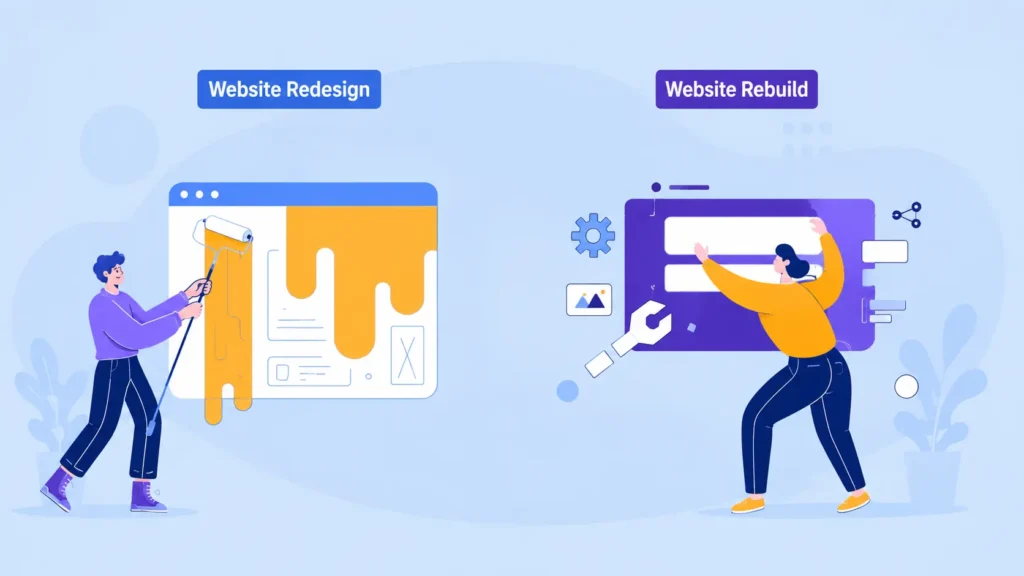
An outdated website creates an awkward decision.
Do you improve what you already have, or stop putting money into an ageing platform and rebuild it properly?
For businesses considering a website redesign on the Gold Coast, that decision should come before colours, fonts, homepage concepts or design trends.
A website can look tired and still have a workable foundation. Another can look reasonably modern while hiding technical workarounds, poor mobile behaviour and structural problems underneath.
The visible design is only one part of the diagnosis.
When we review an existing website, we look at the platform, page structure, mobile experience, content, search visibility, functionality, security and whether the site can support what the business wants to do next.
Sometimes targeted improvements are enough. Sometimes rebuilding is the cleaner decision.
The aim is to know which situation you are dealing with before spending money.
Website Redesign Gold Coast: Start With the Problem, Not the Appearance
A website redesign should solve a business or customer problem.
You might need to present your business more professionally, make services easier to understand, improve mobile usability or create a clearer path from visiting the website to making an enquiry.
Those problems do not automatically require a complete rebuild.
If the existing website uses a secure, manageable platform, the structure still makes sense and the technical foundation remains sound, much of the existing site may be worth retaining.
Changing colours, replacing a hero image and modernising a few layouts will not solve a website that is difficult to maintain, poorly structured or dependent on years of temporary fixes.
That is where a cosmetic redesign can become false economy.
A redesign makes sense when the underlying website is still healthy
A targeted redesign may be enough when the content management system is supported, the website can be updated without excessive development work and the existing templates can accommodate the improvements you need.
Perhaps the branding has changed since the site was built. Maybe the service pages feel dated, calls to action are weak or the mobile layouts need refinement.
Those are different problems from a failing platform.
If the technical foundation remains sound, improving the presentation, content, usability and conversion paths can be more sensible than replacing everything.
Cosmetic changes stop working when the problems are structural
Structural problems behave differently.
You change one template and discover another page depends on it. You update part of the site and something else breaks. A new service needs its own page, but the navigation cannot accommodate it cleanly.
Forms, integrations and old content can also accumulate until making ordinary changes becomes unnecessarily complicated.
At that point, the better question is not whether the website can be redesigned.
It is whether continuing to modify the existing site is still the best investment.
Five Signs Your Existing Website May Be Worth Redesigning
Not every ageing website needs to be replaced.
Before considering a website rebuild on the Gold Coast, it makes sense to understand what is still doing its job.
The CMS is secure, supported and easy to maintain
A flexible, properly maintained content management system gives you something worth working with.
If your team can manage content, the software remains supported and routine updates can be handled safely, targeted development may offer better value than starting again.
The condition of the platform matters more than its age alone.
Your strongest pages and rankings are still performing
An established website may contain assets that have taken years to build.
Some pages may attract organic traffic. Others may generate enquiries, earn links or rank for commercially valuable searches.
Those assets should not be discarded simply because the homepage looks dated.
Before major redevelopment, useful URLs, content, internal links and existing search performance should be reviewed so valuable parts of the website can be preserved.
The problems can be isolated without rebuilding the whole site
Sometimes the weaknesses are relatively contained.
The navigation may need simplifying. Service pages may need stronger copy. The contact form could be cumbersome. The homepage may no longer reflect the business. Mobile spacing may be inconsistent.
If those problems can be fixed without constantly fighting the platform underneath them, a redesign may provide everything the business needs.
When a Website Rebuild Becomes the Smarter Commercial Decision
A rebuild becomes more attractive when the existing website starts limiting every improvement.
The cost is not only development. It is also the time spent working around old systems, the opportunities you cannot pursue easily and the repeated fixes that never address the underlying problem.
An outdated CMS can turn every improvement into another workaround
An ageing or restrictive content management system can turn routine website changes into development projects.
Adding a landing page may require custom work. Updating a service page can cause formatting problems. A new booking, CRM or marketing integration may depend on a workaround because the platform was never designed to support it.
One workaround is not necessarily a reason to rebuild. A pattern of them is more significant.
If every new requirement adds cost, complexity or another dependency, it is worth comparing the cost of maintaining the existing website with rebuilding on a cleaner, more flexible foundation.
Poor mobile performance often reveals deeper structural problems
A mobile problem is not always a mobile-only problem.
An older site may use layouts designed around fixed desktop widths, navigation that collapses badly, oversized imagery, difficult forms or templates that cannot adapt properly to different screen sizes.
Isolated responsive issues can often be improved.
When mobile problems run through most templates, forms and navigation, rebuilding may be more efficient than correcting the same structural weakness page by page.
Security Problems Can Change the Redesign Conversation Completely
Security issues deserve closer scrutiny because the visible website may reveal very little about what is happening underneath.
A compromised or badly maintained site may need more than visual work
WordPress websites rely on the CMS, themes, plugins, hosting and ongoing maintenance working together.
Neglected software can contribute to compatibility problems, broken functionality and security vulnerabilities.
A hacked website does not automatically require a rebuild, but it does justify a deeper assessment.
The important questions are what was compromised, whether the existing software can be cleaned and maintained safely, and whether the underlying environment remains worth keeping.
Rebuilding gives us an opportunity to remove inherited technical baggage
An older website may contain unsupported extensions, abandoned code, duplicated functionality or years of uncertain modifications.
A rebuild creates an opportunity to decide what still serves a purpose and what should be left behind.
For our development work, WordPress provides a flexible foundation that businesses can continue managing and expanding after launch.
The objective is not to move old problems into a newer-looking website. It is to build a cleaner platform around what the business actually needs.
Your Website Structure May No Longer Match the Business You Run Today
Businesses often change faster than their websites.
A site that worked when the company offered three services may become awkward after new services, locations, team members, resources and campaigns are added.
New services, locations and customer journeys can expose an old sitemap
An old website structure may force too much information into a handful of broad pages.
That becomes a problem when customers are searching for something specific and cannot find a clear path to the answer.
It can also make it harder to organise service pages, URLs, headings and internal links around the topics the business now needs to communicate.
If the business has outgrown its original sitemap, changing the visual design without changing the structure can leave the larger problem untouched.
Reorganising the structure can be more valuable than modernising the design
Visitors should not need to understand your internal business structure to use your website.
They should be able to recognise what you offer, find relevant information, see enough evidence to continue and reach an obvious enquiry path.
That may require reorganising pages, separating services that have been forced together, rewriting navigation labels or creating clearer relationships between supporting content and commercial pages.
Sometimes that can happen inside the existing site. Sometimes the current templates make a clean rebuild more practical.
Redesign or Rebuild? Use This Decision Framework Before Spending Anything
The distinction becomes clearer when you stop asking whether the website simply “looks old” and assess its foundation instead.
| A redesign may be enough when… | A rebuild may make more sense when… |
| The CMS is supported and manageable | The CMS is obsolete, restrictive or difficult to maintain |
| The existing structure still reflects the business | The sitemap no longer matches services or customer journeys |
| Problems are limited to specific areas | Fixing one issue repeatedly creates another |
| Mobile issues can be corrected within existing templates | Mobile problems affect templates, navigation and forms throughout the site |
| Existing functionality can be expanded cleanly | New functionality requires awkward workarounds |
| Valuable pages and URLs can remain largely intact | Major structural and technical changes are already required |
Choose a redesign when the foundation still supports your next stage
A redesign is a strong candidate when:
- the CMS remains secure and supportable
- the website can be edited without excessive technical difficulty
- existing URLs and content still have value
- the structure broadly reflects the business
- required functionality can be added cleanly
- mobile and performance issues can be corrected without replacing the whole template system
In that situation, the website may simply need better presentation, content, usability and conversion thinking.
Choose a rebuild when fixing one problem keeps creating another
A rebuild becomes easier to justify when the website is difficult to maintain, badly structured or dependent on years of workarounds.
A technically sound website usually gives you options. A weak foundation gradually removes them.
If simple improvements repeatedly require custom fixes, the cost and complexity of preserving the old website can eventually outweigh the value of keeping it.
What We Check Before Recommending a Website Rebuild
We prefer to diagnose before prescribing.
A website does not deserve a rebuild simply because a new one would be easier to design.
We review what should be preserved before deciding what should change
An existing site may contain valuable pages, established rankings, enquiry paths, customer information, blog content and URLs with search history.
Those deserve examination.
We review what appears to be contributing value and what is getting in the way. That can include the sitemap, navigation, service content, calls to action, mobile behaviour and search performance.
The aim is to separate assets worth retaining from problems worth removing.
We assess whether the current platform can realistically support the business
Can the CMS handle new pages and functionality? Is editing manageable? Are plugins and themes maintainable? Can the navigation expand without becoming confusing?
We also consider what the business plans to do next.
A website that only just meets today’s requirements may become expensive if the business already expects to add new locations, stronger SEO pages, integrations, eCommerce or additional lead-generation functionality.
A Rebuild Should Protect SEO Equity, Not Throw It Away
One of the biggest rebuild mistakes is treating the existing website as though it has no history.
Search engines may already know its pages. Some URLs may rank. Other websites may link to them. Customers may have bookmarks. Advertising campaigns may use existing landing pages.
Changing everything without a migration plan can break those connections.
Existing rankings and URLs need a migration plan
Before launch, it is important to understand which URLs should remain, which pages need improvement and which pages are genuinely obsolete.
Where URLs change, redirects may be needed so users and search engines reach the closest appropriate destination.
Useful content should be assessed rather than deleted automatically. Internal links, forms, tracking, metadata and conversion paths should also be checked during the transition.
Search performance should be considered before development begins
SEO becomes harder to repair after every template, page and URL has already been approved.
Considering search visibility during planning allows more deliberate decisions about hierarchy, page topics, URLs, headings and internal links.
A rebuild should leave the business with a stronger website foundation, not a new design followed by avoidable SEO repairs.
The Best Website Rebuilds Improve the Customer Journey as Well as the Technology
A technically strong website can still underperform if customers cannot work out what to do.
That is why the build and the customer journey need to support each other.
A modern website should make your business easier to understand
Within a short visit, a potential customer should be able to answer a few basic questions:
- What does this business offer?
- Is it relevant to me?
- Is there enough information for me to keep considering it?
- What should I do next?
Clear service pages, practical navigation, useful proof and obvious contact paths help remove uncertainty.
Better design earns its place when it helps visitors move towards an enquiry
Visual design has a commercial job.
Typography affects readability. Spacing affects comprehension. Page hierarchy changes what people notice first. Button placement affects whether the next step is obvious.
A redesign that improves those areas is doing useful work.
Changing the visual style without improving the customer experience may not solve the real problem.
For Gold Coast Businesses, Local Buying Behaviour Belongs in the Rebuild Plan
Local customers may compare several providers before making contact.
Your website therefore needs to support the evaluation process, not simply help someone discover the business.
GCWebsites operates from Varsity Lakes and works with businesses across the Gold Coast, as well as clients elsewhere in Queensland and Australia.
For local service businesses, mobile usability, clear services, credibility and straightforward enquiry paths all deserve attention when a site is redesigned or rebuilt.
Mobile visitors need fast access to services, proof and contact information
A customer using a phone should not have to fight the website.
Menus need to work properly. Text should remain readable. Buttons need enough space. Forms should be manageable. Important information should not disappear on smaller screens.
Mobile responsiveness should be considered during design and development rather than treated as a final technical check.
Your website should make the next step obvious
A good local business website should not leave visitors wondering how to move forward.
If someone is ready to enquire, request a quote or discuss a project, that action should be easy to find.
That does not mean placing aggressive buttons after every paragraph. The next step should feel like a natural part of the customer journey.
Before You Commit to a Website Redesign, Ask These Questions
Before investing in a redesign or rebuild, step away from the current appearance for a moment.
Can the current website support where the business is going?
Think beyond what the website needs today.
Are you planning new services? More locations? Additional landing pages? Stronger SEO activity? eCommerce? Online bookings? CRM integration? More content?
If the existing website can support those requirements cleanly, improving it may be enough.
If every new requirement creates another technical compromise, rebuilding starts to make more sense.
Are we repairing isolated issues, or continually working around the same foundation?
This is often the decisive question.
An isolated problem can usually be fixed.
A pattern of recurring problems suggests that the limitation sits deeper in the website.
If every improvement exposes another obstacle, the cost of preserving the old website may eventually become harder to justify.
We Can Help You Work Out Which Option Makes More Sense
We do not think a business should rebuild its website simply because it looks dated.
The better starting point is understanding what still works, what is holding performance back and whether the existing platform can support what the business needs next.
If the foundation is healthy, a targeted redesign may be the smarter investment.
If outdated technology, poor mobile performance, structural limitations, security problems or years of workarounds are getting in the way, a planned rebuild may provide a cleaner path forward.
Our WordPress website design service takes that broader view of the website rather than treating design in isolation.
You can also read our guide to website makeovers and what tends to work or fail if you want to explore the decision further.
When you are ready for a practical recommendation, contact our Gold Coast website team. We can review what you already have, discuss what the business needs from its next website and determine whether targeted improvements or a complete rebuild make more sense.
Questions Business Owners Usually Ask Just Before Making the Call
Can you redesign my website without rebuilding it?
Yes, in some cases.
If the existing platform remains secure, manageable and technically sound, it may be possible to retain the foundation while improving the design, content, navigation and mobile experience.
The condition of the current website should be assessed before deciding how much needs to change.
How do I know whether my CMS is too outdated to keep?
Look at what happens when you try to make ordinary changes.
If the CMS is unsupported, difficult to update, dependent on obsolete components or repeatedly requires development workarounds, maintaining it may become harder to justify.
The other question is whether it can support the functionality and content the business is likely to need next.
Will rebuilding my website hurt my Google rankings?
A rebuild can affect search performance if the transition is poorly handled, but replacing a website does not automatically mean losing rankings.
Existing URLs, useful content, internal links and search visibility should be reviewed before launch. Where URLs change, appropriate redirects and migration planning can help preserve important connections.
Should I keep the content from my current website?
Keep content because it is useful, commercially relevant or performing well, not simply because it already exists.
Strong pages may deserve to be retained or improved. Thin, outdated or duplicated content may need to be rewritten, consolidated or removed as part of a planned migration.
Is poor mobile performance enough reason to rebuild?
Not necessarily.
A few responsive layout problems may be fixable inside the existing website.
If poor mobile behaviour affects templates, navigation, forms and page structure throughout the site, rebuilding may become the cleaner option.
What happens if my website has been hacked or has recurring security problems?
The first step is understanding the source and extent of the problem.
Some websites can be cleaned, secured and maintained successfully. Where the technical environment is heavily compromised, outdated or difficult to maintain, rebuilding on a cleaner setup may be more practical.
How much does a website redesign or rebuild cost on the Gold Coast?
The cost depends on the scope of the project rather than whether it is labelled a redesign or rebuild.
Page count, functionality, design requirements, content, integrations and the condition of the existing website can all affect the final quote.
A proper assessment is the best way to determine what work is actually required before putting a figure against the project.
What should I do before asking for a website redesign quote?
Start with the outcome you need rather than trying to write a technical specification.
Note what the current website struggles with, which services or products need to be promoted, who the audience is, what functionality is essential and what you expect the website to support over the next few years.
That gives us a much stronger basis for deciding whether you need a redesign, redevelopment or complete rebuild.