
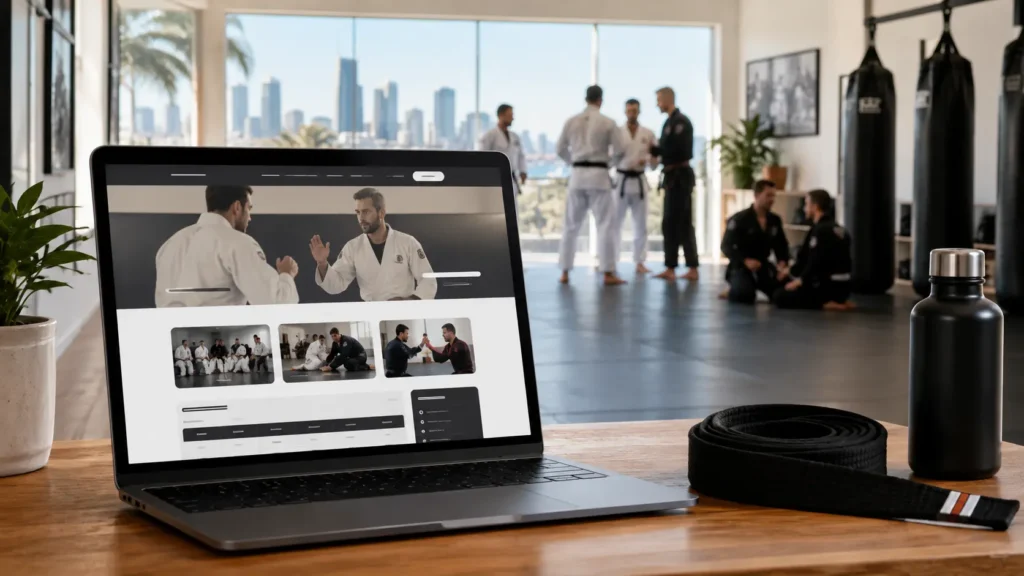
Someone searches for martial arts training in their area. They find your centre, tap through to your website and start looking for a class.
At that point, they are already interested.
The website does not need to manufacture demand from nothing. It needs to make that existing interest easy to act on.
That sounds straightforward, but many martial arts websites make prospective students work surprisingly hard. Classes are buried inside generic service pages. Timetables are difficult to read on a phone. Beginner information is scattered around the site. The only obvious next step may be a general contact form that gives little indication of what happens after it is submitted.
We approach martial arts website design differently.
For martial arts schools, gyms and training centres, we want the website to help prospective members move naturally from curiosity to understanding, then from understanding to a trial or enquiry.
The design matters, but the structure is just as important.
Your Next Student May Be Judging Your Martial Arts Centre From Their Phone
A prospective student might first discover your centre while sitting at home, travelling to work or searching for something for their child.
They may know almost nothing about you.
Their first questions are usually practical.
What classes do you offer? Are beginners welcome? Is there something suitable for children or adults? Where are you located? When are classes held? Can they try a session before committing?
If those answers are easy to find, the website helps maintain the interest that brought them there.
If visitors have to hunt for them, that interest has more opportunities to disappear.
Make Classes Easy to Understand Quickly
A martial arts centre can offer an impressive range of programs and still present them poorly online.
Brazilian jiu-jitsu, karate, kickboxing, MMA, children’s programs, beginner sessions, advanced classes and private training can quickly become a wall of information if the website is not organised around the visitor.
We would rather make the choice easier.
Each major class or program should explain who it is for, what someone can expect and where they should go next if they are interested.
The wording also needs to recognise that visitors arrive with different levels of knowledge. Someone who has trained for years may understand the terminology immediately. A parent looking for their child’s first martial arts class may not.
Good class presentation should work for both.
A Confusing Mobile Journey Can Lose Interest Before the First Class
Mobile design deserves more than shrinking a desktop page until it technically fits a smaller screen.
Think about how somebody actually searches.
They might open Google, compare several nearby martial arts centres, check class times and decide which one to contact, all from the same phone.
That mobile journey reflects how Australians now use the internet more broadly. According to the Australian Communications and Media Authority, 97% of Australian adults used a mobile phone to access the internet in 2025, while 91% did so multiple times a day. For a martial arts centre, that makes a clear and usable mobile experience an important part of helping prospective students move from searching to enquiring.
If your timetable requires zooming, your navigation hides class information or the enquiry form becomes tedious on a small screen, the website introduces friction at exactly the point where the visitor is considering taking action.
We build responsive WordPress websites with that journey in mind.
Visitors should be able to understand your classes and take the next step comfortably from the same device.
Make Every Class Easier to Find, Understand and Enquire About
A prospective member should not need existing knowledge of your school to understand your programs.
This is where dedicated class information can help.
A clear martial arts class page can explain the training style, intended audience, experience level and practical details while giving the visitor a relevant next action.
That is more useful than putting every discipline into one broad paragraph and expecting people to work out which option suits them.
Class Pages Should Sell the Right Outcome Without Overselling the Training
People choose martial arts for different reasons.
Some want fitness. Some want competition. Parents may be looking for an organised physical activity for their children. Others want to learn a discipline, meet people or return to training after years away.
A class page should help the right person recognise that the program may suit them.
It does not need inflated promises.
Clear information usually works harder. We would rather explain who a class is designed for, what the training involves and what a newcomer should expect than fill the page with claims that cannot be supported.
That approach is better for the prospective student and gives the centre a stronger foundation for turning relevant website traffic into genuine enquiries.
Turn the Timetable From a Friction Point Into a Reason to Take Action
For a martial arts centre, the timetable is not an administrative footnote.
It can influence the decision.
A visitor might like the school, trust the instructors and be interested in the program, but they still need to know whether the training fits their week.
The easier that answer is to find, the easier it becomes to continue.
A Martial Arts Timetable Should Work on a Phone First
Traditional website timetables can become awkward quickly.
A wide grid may look organised on a desktop monitor, then become nearly unreadable when squeezed onto a phone. Long class names wrap badly. Times become disconnected from programs. Visitors start scrolling sideways or pinching the screen simply to work out what happens on Tuesday night.
We prefer to think about the timetable as part of the user journey.
Classes can be grouped logically by day, program, age group or another structure that suits the centre. Labels should be immediately understandable, and the information should remain readable at normal mobile size.
A timetable has one job: help somebody determine when they can train.
Its design should support that job.
Turn Class Times Into Trial Enquiries
Finding the right session often creates a natural moment of intent.
The visitor has discovered a program they like. They have checked the timetable. A suitable class is available.
The next step should be visible.
If trial sessions are part of the centre’s enrolment process, the visitor should not have to return to the homepage and search for a general contact button. The timetable or class information can lead naturally towards requesting a trial or asking about that particular program.
The website has helped them reach a decision. It should now make acting on that decision straightforward.
Give New Students Confidence Before Their First Visit
Joining a martial arts centre can feel very different from buying an ordinary service.
A new student may be wondering whether they will fit in, whether the training suits their experience level or what the first session will involve.
Parents often have another set of questions about the environment, instructors and suitability of classes for their children.
A website cannot answer every individual concern, but it can remove a lot of unnecessary uncertainty before the first conversation.
Instructor, Facility and Training Information Can Answer Questions Early
Real information builds useful confidence.
Instructor profiles can show visitors who they will be learning from. Genuine photographs can help them understand the training environment. Clear beginner information can explain what to bring, where to go or how the first visit generally works.
The specific content should reflect what the martial arts centre can genuinely substantiate.
We do not need to dress the business up with unsupported claims. We need to make its real strengths easier to see.
For an established martial arts centre, there is usually plenty worth communicating.
The website simply needs to present it properly.
Trial Enquiries Need a Clear Path
“Contact us” has a place on almost every business website.
It is not always the strongest call to action.
Someone researching martial arts classes may not think of themselves as wanting to “contact” a business. They may want to try a class, ask which program suits them or find out whether a beginner session is available.
Those are more specific intentions.
The website can reflect them.
Give Interested Visitors One Obvious Next Step
We prefer calls to action that match what the visitor is already trying to accomplish.
If the centre offers trial sessions, “Enquire About a Trial” or similar wording can make the next step clearer than a generic button.
If trials are not part of the enrolment model, the action should reflect the process the centre actually uses.
The wording is secondary to the principle.
Tell people what they can do next.
Keep the Enquiry Process Easy to Complete on Mobile
A form should collect enough information to start a useful conversation, not interrogate a prospective student.
Name, contact details and a small amount of relevant class information may be enough in many cases. The exact fields depend on the centre and how enquiries are handled.
Every extra requirement adds another decision before submission.
We look at the complete mobile enquiry journey when designing a site because the form itself is only one part. The visitor also needs to find it, understand what it is for and feel comfortable completing it.
Good conversion design removes unnecessary steps while preserving the information the business genuinely needs.
A Martial Arts Marketing Website Should Support More Than One Campaign
A website is often the destination for several different marketing activities.
Someone might arrive through a local Google search. Another visitor could click from a Google Business Profile, social media post or paid campaign. A parent may receive the link from another family at the school.
Those people do not always need the same information.
A well-structured martial arts marketing website gives you somewhere relevant to send them.
Build Pages Around the Classes People Are Actually Searching For
When a martial arts centre offers distinct programs, dedicated pages can help visitors understand them and give search engines clearer information about the site’s subject matter.
That does not mean creating thin pages for every possible keyword variation.
A page should exist because there is enough useful information to justify it.
A children’s program may deserve its own page because parents have different questions from adult students. A specialist discipline may warrant detailed information because prospective members want to understand the training before enquiring.
The structure should follow real customer needs first.
SEO becomes stronger when those needs and the search terms around them naturally overlap.
WordPress Gives Growing Centres More Flexibility
We specialise in custom WordPress websites because the platform gives us flexibility during the build and after launch.
A martial arts centre may begin with a relatively simple site and later want to add more class content, instructor profiles, landing pages, events, news or other resources.
WordPress gives the site room to accommodate those changes without making every future update a new starting point.
We Build Around the Business, Not a Fixed Template
WordPress is the foundation. It does not have to dictate the appearance of the finished site.
We design around the brand, audience, content and goals of the business rather than trying to squeeze every client into an identical layout.
For one martial arts school, class discovery may deserve greater prominence. For another, the schedule may need more attention. A centre with several programs may require a deeper navigation structure than a smaller school.
The right structure depends on the operation behind the website.
That is why discovery comes before design.
Your Website Should Stay Useful After Launch
Launch day gets plenty of attention, but the website has to keep working afterwards.
Class schedules change. New programs appear. Instructor information needs updating. Marketing campaigns create new content requirements.
Our WordPress approach gives businesses a practical content management foundation, and we also provide ongoing website hosting and support where clients want continued technical assistance.
The website should be able to adapt as the business changes.
What We Would Look at First on a Martial Arts Centre Website
If we were reviewing a martial arts website before discussing visual changes, we would begin with the journey a prospective student takes.
These are the five areas we would look at first:
| Area | What to check |
| Class clarity | Can somebody quickly understand what training is available and who each program suits? |
| Timetable usability | Can the schedule be read comfortably on a mobile phone? |
| Mobile experience | Can a visitor move through the core pages without awkward navigation or unnecessary steps? |
| Trust information | Does the site give newcomers enough genuine information about the instructors, environment and first visit? |
| Trial or enquiry pathway | Once someone is interested, is the next action obvious? |
Those questions often reveal more than asking whether the website looks modern.
A visual redesign can make a site feel newer. Structural improvements can make it easier to use.
Ideally, the project achieves both.
See the Standard of Website Design We Bring to Gold Coast Businesses
Every martial arts centre has its own identity, so we would not expect your new website to imitate another organisation.
Our broader work can still help you judge our design capability.
You can browse our web design portfolio to see websites we have created across different businesses and industries.
Look at the variety rather than searching for one design you want copied.
Notice how different brands are presented, how information is organised and how the websites create paths towards the actions those businesses want visitors to take.
That gives you a clearer sense of how we work than a list of design claims ever could.
Ready to Turn More Local Interest Into a Trial Enquiry?
A martial arts website does not need to be complicated to work well.
It needs to make the centre easy to understand.
Prospective students should be able to see what classes are available, find a suitable time, get comfortable with the business and understand exactly what they can do next.
When those pieces work together, the website becomes more than an online brochure. It becomes part of the enrolment journey.
If your current site makes any of those steps harder than they need to be, contact our Gold Coast team.
Show us the current website, tell us how your classes work and explain where you think prospective students are getting stuck.
We can build from there.
Before You Rebuild Your Martial Arts Website, Answer These Questions First
What should a martial arts website show on the homepage?
The homepage should quickly establish what the centre offers, who it serves, where it operates and what an interested visitor can do next.
The strongest structure depends on the business, but prospective students should not have to search through several pages just to understand the basic training options.
Should every martial arts class have its own page?
Not necessarily.
A dedicated page is useful when a class has enough distinct information, audience needs or search interest to justify one. Closely related programs may be clearer when grouped together, while genuinely different classes can benefit from focused pages that explain each option properly.
What is the best way to display a martial arts timetable on mobile?
The timetable should remain readable without requiring visitors to zoom or scroll sideways.
Clear day headings, class names, times and logical grouping usually work better than forcing a large desktop-style grid onto a narrow screen. The best format depends on the number of classes and how the schedule is organised.
Should a martial arts website use “Book a Trial” or “Contact Us”?
Use the call to action that reflects what visitors can genuinely do.
If the centre offers trials, trial-focused wording can make the next step more specific. If prospective students need to speak with the centre before choosing a class, an enquiry-focused action may be more appropriate.
Can a gym or martial arts website help with local SEO?
Yes, the website can support local search visibility when it clearly explains the services offered, provides accurate location information and contains useful pages around genuine programs and customer needs.
A strong site structure also gives search engines clearer context.
No website can guarantee rankings, but better relevance and organisation create a stronger foundation for local SEO.